
How to Choose a Pellet Grill: The Specs That Actually Matter
As an Amazon Associate we earn from qualifying purchases. Product links on this page may be affiliate links.
A pellet grill is the only backyard cooker that runs on a thermostat. You set a number, the machine feeds wood pellets to keep that number, and you walk away. That convenience is why they have taken over so many patios — and also why so many people buy the wrong one.
This guide walks through what actually separates a pellet grill you will still be using in five years from one that frustrates you by the second summer. No rankings, no "we tested twelve models" — just the specifications that matter, what they mean in practice, and where the honest trade-offs are.
- How a pellet grill works, in one paragraph
- The controller is the single most important part
- Temperature range — and the searing problem
- Hopper capacity: how long can you leave it?
- How much cooking area do you actually need?
- The specs that matter less than you would think
- Build details worth a closer look
- Pellets are part of the buying decision
- A checklist before you buy
- Where to go from here
How a pellet grill works, in one paragraph
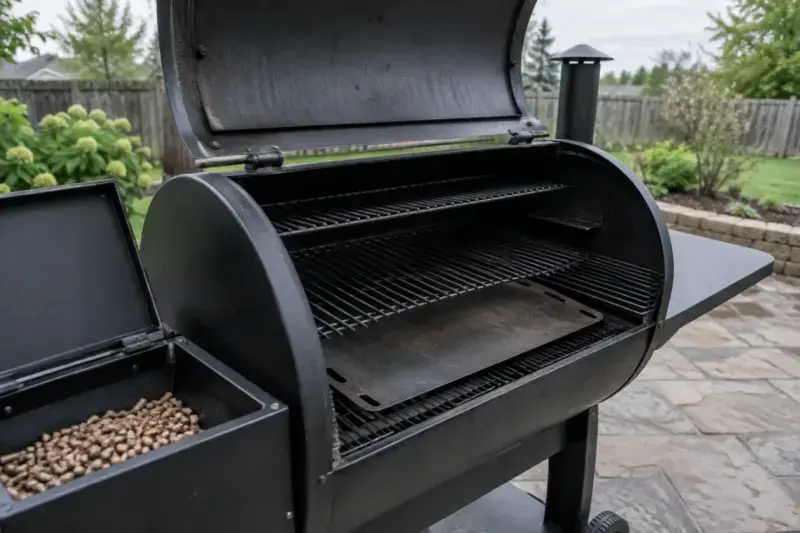
Hardwood pellets sit in a hopper. A motorized auger feeds them into a fire pot. An igniter lights them, a fan feeds the fire air, and a controller decides how fast the auger turns and how hard the fan blows. Heat and smoke circulate through the cooking chamber. Everything else — the app, the meat probes, the extra shelves — is built on top of those four parts. When you understand that, every spec on the box starts to mean something.
The controller is the single most important part
If you only compare one specification between two grills, make it this one.
Standard controllers
A standard controller works on timing: it feeds pellets to the fire pot on a fixed cycle to approach the temperature you set. It is simple and cheap, and it works — but it reacts slowly and it does not know what the weather is doing.
PID controllers
A PID controller adds three variables — Proportional, Integral and Derivative — and uses them to adjust the auger feed rate and the fan speed continuously. According to Pit Boss's own technical explanation, a PID controller senses and adapts to external influences such as ambient heat and wind with more speed and precision than a standard controller can.
In practice, a PID-equipped grill typically holds the set temperature within roughly ±5–10 °F, while a standard controller wanders considerably more.
Why every pellet grill still swings a little
Here is a detail that surprises new owners: no pellet grill holds a perfectly flat line. The auger drops pellets, the fire grows, the temperature rises; the controller cuts fuel, the fire shrinks, the temperature falls. That cycle is inherent to the design. A PID controller narrows the swing — it does not abolish it.
If a listing promises a dead-flat temperature, treat it as marketing rather than physics.
What to look for: PID control used to be reserved for premium models. It has since spread through the mid-range, so it is worth checking the spec sheet rather than assuming it tracks price. You can compare pellet grills with PID controllers on Amazon and read the control description before deciding.
Temperature range — and the searing problem
This is the honest weak spot of the category, and it is worth knowing before you buy rather than after.
Most pellet grills top out around 500 °F. Consumer Reports notes that many gas and charcoal grills they have tested reach up to 800 °F, and concludes that pellet grills suit people who want smoke flavor and are not especially focused on searing. If you have not settled on a fuel type yet, the comparison of charcoal, gas, pellet and kamado is the decision to make first.
500 °F will brown a steak and crust a burger. It will not give you the hard, fast sear a screaming-hot charcoal grate produces.
Direct-flame features
Manufacturers have responded with sear plates: a slotted metal panel that slides across the heat deflector to expose the flame underneath. Pit Boss calls its version the Flame Broiler and rates direct searing over the open flame far above the chamber's normal ceiling.
The practical question to ask yourself: do you want one cooker that does everything adequately, or a pellet grill for low-and-slow plus something else for high heat? Plenty of people run a pellet grill alongside a charcoal kettle for exactly this reason, and the two together cost less than one do-everything unit.
Hopper capacity: how long can you leave it?
The hopper determines how long the grill runs unattended — which is the entire point of owning one.
- 20–22 lb — the common size. Comfortably covers an overnight brisket in mild weather.
- 35 lb — found on larger and upgraded models. Approaches a full day of unattended running.
Two things shorten hopper life more than the numbers suggest: cold weather and high set temperatures. A grill running at 250 °F in July and the same grill at 250 °F in January are not consuming pellets at the same rate.
Also check for a hopper clean-out door. Without one, switching pellet flavors or clearing pellets that have absorbed moisture means scooping the hopper by hand.
How much cooking area do you actually need?
The arithmetic is the same whatever the fuel: work out what you cook at once, then compare usable primary grate area. What size grill do you need works through it with real numbers.
The widely used rule of thumb is about 72 square inches per person. Applied to real groups, that works out roughly like this:
| Total cooking area | Suits |
|---|---|
| 184–500 sq in | 3–7 people |
| 600–820 sq in | 8–11 people |
| 900–1,300 sq in | 12–18 people |
| 2,000–2,500 sq in | 20–34 people (commercial) |
For a family of four, most buying guides land on 400–600 square inches.
One caveat on the marketing numbers: manufacturers usually quote total area, which includes upper warming racks. Those racks are useful for holding finished food or running sausages, but they are not full-heat cooking space. Compare the main grate area when you are weighing two models against each other.
The specs that matter less than you would think
- Wi-Fi and apps. Genuinely convenient for an overnight cook. But an app cannot compensate for a controller that will not hold temperature, and a grill with a good controller and no app beats the reverse.
- Number of included meat probes. Built-in probes drift over time and are the first component people replace. A separate instant-read thermometer is worth more than a third built-in probe. See our thermometer guides for what to look for.
- Maximum advertised temperature. Reaching 500 °F and holding 500 °F with a full grate of cold food are different things.
Build details worth a closer look
- Gauge of the steel. Thin walls lose heat in wind and cold, which makes the controller work harder and burns more pellets.
- Grease management. A grease path that drains into an accessible bucket saves a genuinely unpleasant job later.
- Ash clean-out. Some designs require removing grates and deflector to vacuum the fire pot; others have a dump mechanism. You will do this often.
- Gasket and lid fit. Smoke escaping around a poorly fitted lid is heat that never reached your food.
Pellets are part of the buying decision
Pellet grills are only as consistent as what you feed them. Pellets that have absorbed moisture swell, jam augers and burn unevenly — the single most common cause of "my grill stopped holding temperature."
Buy hardwood pellets intended for cooking rather than heating, store them sealed and dry, and do not leave them in the hopper between cooks in humid weather. You can browse cooking wood pellets on Amazon — brand matters less than dryness and hardwood content.
A checklist before you buy
- Does it have a PID controller? If the listing does not say, assume it does not.
- What is the main grate area, excluding warming racks?
- Hopper capacity, and is there a clean-out door?
- Is there a direct-flame sear option, and do you need one?
- How do you empty the ash and where does the grease go?
- Are replacement parts — controller, auger motor, igniter — sold separately? On a machine with moving parts, this matters more than any feature.
That last point is the one most buying guides skip. A pellet grill is an appliance with an electric motor, a fan and an igniter. All three eventually fail. A manufacturer that sells those parts individually is telling you something about how long they expect the grill to last.
Where to go from here
If you are still weighing fuel types rather than models, start with the wider comparison in our grills section. If you have decided on pellets and want to see how the format handles long cooks, our pellet smoker coverage goes deeper on low-and-slow. And whichever way you go, a reliable thermometer will improve your results more than almost any upgrade to the cooker itself.
If you want to know other articles similar to How to Choose a Pellet Grill: The Specs That Actually Matter you can visit the category Pellet Grills.