
What Size Grill Do You Need? Cooking Area, Explained Properly
As an Amazon Associate we earn from qualifying purchases. Product links on this page may be affiliate links.
Grill size is the specification people get wrong most often, in both directions. Buy too small and every gathering becomes a relay of batches. Buy too big and you burn fuel heating empty steel for the ninety per cent of cooks that are four burgers on a Tuesday.
The number on the box is also not quite the number you should be comparing. Here is how to work out what you actually need.
Table of Contents
- The starting rule: 72 square inches per person
- The number manufacturers quote is not the number that cooks
- Size for your typical cook, not your biggest one
- Think in food, not just square inches
- Measure your space, not just the grill
- Portable grills follow different rules
- A three-question shortcut
- Next steps
The starting rule: 72 square inches per person
The figure used across most buying guides is roughly 72 square inches of cooking surface per person. It is a rule of thumb rather than a law, but it holds up because it assumes a real plate of food rather than a single patty.
| Total cooking area | Comfortably serves |
|---|---|
| 184–500 sq in | 3–7 people |
| 600–820 sq in | 8–11 people |
| 900–1,300 sq in | 12–18 people |
| 2,000–2,500 sq in | 20–34 people (commercial scale) |
For a family of four, most guides land on 400–600 square inches — enough to cook a full dinner in one pass with room to move food around.
The number manufacturers quote is not the number that cooks
This is the single most useful thing on this page.
Advertised figures are almost always total cooking area, which includes upper warming racks. Those racks are genuinely useful — for resting finished food, holding sausages, keeping buns warm — but they are not full-heat cooking surface. Food on the upper rack cooks slower and browns less.
When you compare two grills, compare the main grate area. A model advertised at 700 square inches with 500 on the main grate and 200 on a warming rack is a smaller cooker than one advertised at 620 with 620 on the main grate. The spec sheet usually breaks it down if you look past the headline.
Size for your typical cook, not your biggest one
People buy for the party they host twice a year and then live with that grill 150 other times.
A large grill running mostly empty costs you in three ways: more fuel to bring the mass up to temperature, longer preheat, and — on charcoal and kamado especially — more awkward fire management because a small fire in a big chamber behaves differently than a small fire in a small one.
The better approach is to size for your normal cook and solve the occasional crowd another way: cook in two passes and hold the first batch in a low oven, or borrow a second cooker. Two passes on a right-sized grill beats fifty weeknight cooks on an oversized one.
Think in food, not just square inches
Abstract numbers are hard to picture. Rough guidance that helps:
- A standard burger takes about 16–20 square inches including the space to flip it.
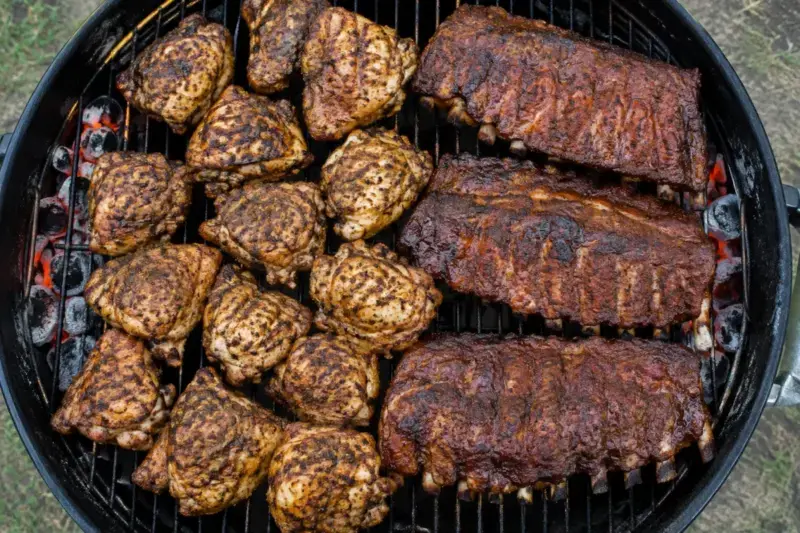
- A full rack of ribs laid flat needs roughly a foot and a half of grate length; on smaller grills you will be cutting racks in half or standing them in a rib rack.
- A whole packer brisket is a genuine constraint — check the grate's longest dimension, not just its area, before assuming it fits.
- You need space you leave empty. Two-zone cooking — hot side, cool side — is how you stop burning the outside before the middle is done. A grill packed corner to corner has no cool side.
That last point undoes a lot of "I bought the right size" calculations. Budget roughly a third of the grate as your safety zone.
Measure your space, not just the grill
Cooking area is one dimension. The others matter too:
- Lid clearance. Grills open upward. Under a low eave or a pergola beam, an open lid can hit before it is fully open.
- Clearance from combustible surfaces. Check the manufacturer's stated minimum distances to walls and railings. Kamados and charcoal grills radiate heat from the body, not only the top.
- Where it lives in winter. A grill you have to drag is a grill you use less. Check the wheels — two fixed wheels and two feet is common and makes moving over grass or gravel harder than it sounds.
- Side shelves. Not a luxury. Somewhere to set a tray of raw meat and then a clean tray for cooked is basic food safety, and doing without means trips back to the kitchen at the worst moments.
Portable grills follow different rules
If the grill is going camping or to a tailgate, weight and footprint override cooking area. Small units cluster around 150–250 square inches — enough for four to six burgers, which is usually what portability is for. Check that the lid latches for transport and that the legs fold without needing tools.
Our coverage of portable grills goes into the specific trade-offs there.
A three-question shortcut
- How many people do you cook for on a normal weekend? Multiply by 72 square inches. That is your floor.
- Add a third for the cool zone you need for two-zone cooking.
- Check that the main grate — not the total including warming racks — meets that figure.
Anything beyond that is buying capacity you will heat but not use.
Next steps
If you have not settled on a fuel type yet, that decision comes first — see our comparison of charcoal, gas, pellet and kamado. If you have chosen pellets, the pellet grill specification guide covers the controller and hopper questions that matter more than size. And you can compare grills by cooking area on Amazon with the main-grate caveat above in mind.
If you want to know other articles similar to What Size Grill Do You Need? Cooking Area, Explained Properly you can visit the category BBQ GRILLS.
More embers