
How to Choose a Charcoal Grill: Vents, Steel and Shape
As an Amazon Associate we earn from qualifying purchases. Product links on this page may be affiliate links.
A charcoal grill has no electronics, no moving parts and nothing to break. That simplicity is its strength — and it means the few things it does have need to be right. There is nowhere for a bad design to hide behind a feature list.
Four things decide whether a charcoal grill is a pleasure or a chore: how it breathes, how thick its steel is, what shape it is, and how you get the ash out. Everything else is trim.
Airflow is the thermostat
On a charcoal grill, you are the temperature controller, and the vents are your instrument. Fire needs oxygen: more air means higher heat, less air means lower. That is the whole mechanism.
What separates a good design from a frustrating one:
- Vents at both ends. An intake vent at the bottom and an exhaust at the lid. With both, you control how much air enters and how fast heat leaves — two independent levers. With only one, you are guessing.
- Defined increments. Vents should move in smooth, repeatable steps. A vent that slides loosely gives you no way to return to a setting that worked last time. This is the difference between "a quarter open" meaning something and meaning nothing.
- The full range. Wide open for searing, nearly shut for low-and-slow. A grill whose vents cannot close down far enough simply cannot hold 225 °F, regardless of what the marketing says.
If you can inspect a grill in person, work the vents before anything else. Sticky, vague or rattling vents tell you more about the build than the price tag does.
Steel thickness: the thermal battery
This is the specification that most separates grills that look alike.
- Around 1.0 mm — heats fast, loses heat just as fast. Every lid opening is a temperature crash, and a cold or windy day fights you the whole cook.
- 1.2 mm and above — noticeably better heat retention and far more resistance to warping after years of high-heat cooks.
- 1.5–2.0 mm — behaves like a thermal battery, smoothing the spikes and dips that make long cooks tiring.
Thicker steel costs more and weighs more, and for a grill that only ever sears burgers on summer evenings, thin is survivable. For anything long, slow, or cooked in cold weather, thickness is the difference between managing a fire and fighting one.
Weight is a reasonable proxy when the gauge is not published: between two grills of the same size, the heavier one is usually the better-built one.
Kettle or barrel?
The two dominant shapes cook differently, and the reason is geometry rather than quality.
Kettle
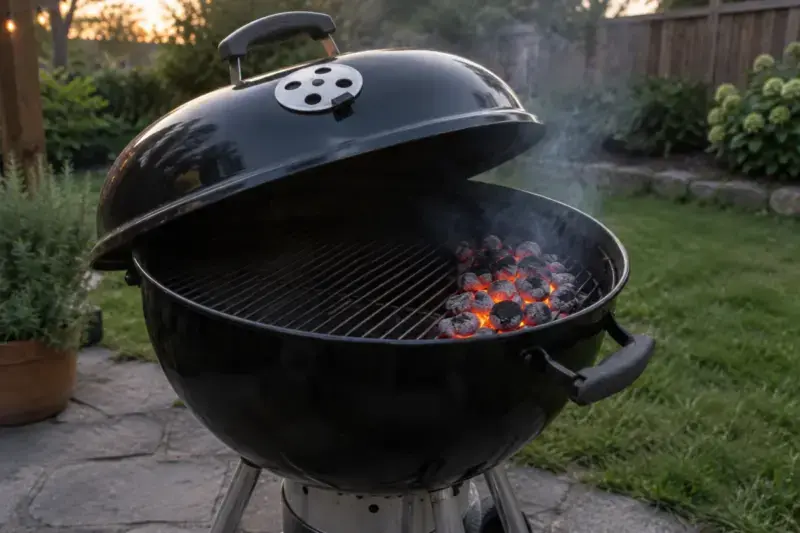
Round, vertical, compact. The shape retains heat well for its size, the footprint is small and it is the most portable and least expensive of the two. The trade-off is grate area and shape: a round grate is awkward for long cuts, and a full rack of ribs usually has to be cut or stood in a rack.
It is also the format with the longest track record — the Weber Kettle has been in production for six decades with remarkably little changed, which says something about how well the geometry works.
Barrel
Horizontal and cylindrical. The fire sits at one end and the exhaust at the other, so smoke travels a longer path across the food than in a kettle's vertical chamber. That produces more pronounced smoke flavor and a better-defined smoke ring and bark.
The flat rectangular grate also suits long cuts far better — briskets and whole rib racks lie flat without acrobatics. The costs are footprint and, usually, price.
The short answer: kettle if you mostly grill and occasionally smoke; barrel if you mostly smoke and want offset-style behaviour without an offset's price.
Ash removal: the job you will do most
Every charcoal cook ends in ash, and how the grill handles it determines whether cleanup takes two minutes or fifteen.
The designs, best to worst:
- Ash drawer or pan — pull it out, empty it, slide it back. Nothing else comes apart.
- Ash basket or sweep — vanes under the bowl push ash into a removable catcher.
- Nothing — you remove the grates and the coal grate and scoop it out by hand, usually while it is still slightly warm.
This sounds like a minor convenience and it is not. Ash that builds up blocks the intake vents, which means your airflow control gets worse exactly as the ash gets deeper — the grill becomes harder to run the longer you go without cleaning it.
The details that reveal build quality
- Lid fit. Smoke escaping around a badly seated lid is airflow you are not controlling. Hold the lid down and look for daylight.
- Grate material. Heavy cast iron holds heat and leaves better sear marks; plated steel is lighter and cheaper and will eventually chip. Neither is wrong, but know which you are buying.
- Adjustable coal grate. Being able to raise or lower the fuel bed changes your heat without touching the vents. It is a genuinely useful feature and not common at entry level.
- Hinged or removable grate section. Adding coals mid-cook without lifting a grate full of food is worth more than it sounds on a long day.
- Legs and wheels. Thin tubular legs on an otherwise heavy grill are the first thing to bend. Look at where the weight actually rests.
What you do not need to pay for
- Built-in lid thermometers. They read the air near the lid, not the temperature at the grate, and they are frequently off by a wide margin. A separate probe thermometer costs little and tells you the truth. See our thermometer coverage for what to look for.
- Ignition gimmicks. A chimney starter lights coals faster and more evenly than any built-in system, costs very little and never breaks.
- Extra shelving you will not use. One solid side shelf beats three flimsy ones.
A buying checklist
- Vents at both top and bottom, moving in defined increments?
- Steel 1.2 mm or thicker — or, failing a published figure, is it heavy for its size?
- Shape matched to your cooking: kettle for grilling, barrel for smoking and long cuts?
- An ash removal mechanism, not just a bowl?
- Does the lid seat properly all the way round?
- Can you add coals without unloading the food?
Six questions, no electronics, nothing to fail. That is the appeal of charcoal — and the reason a well-chosen one tends to outlast everything else on the patio.
Next steps
Still deciding between fuels? Our comparison of charcoal, gas, pellet and kamado lays out the trade-offs. Working out how big to go? See what size grill you need, including why the advertised cooking area is not the figure to compare. And the fuel itself matters more than most people expect — our notes on charcoal types cover briquettes versus lump.
If you want to know other articles similar to How to Choose a Charcoal Grill: Vents, Steel and Shape you can visit the category Charcoal Grills.