
Competition BBQ: How KCBS Contests Work, and How Judges Score
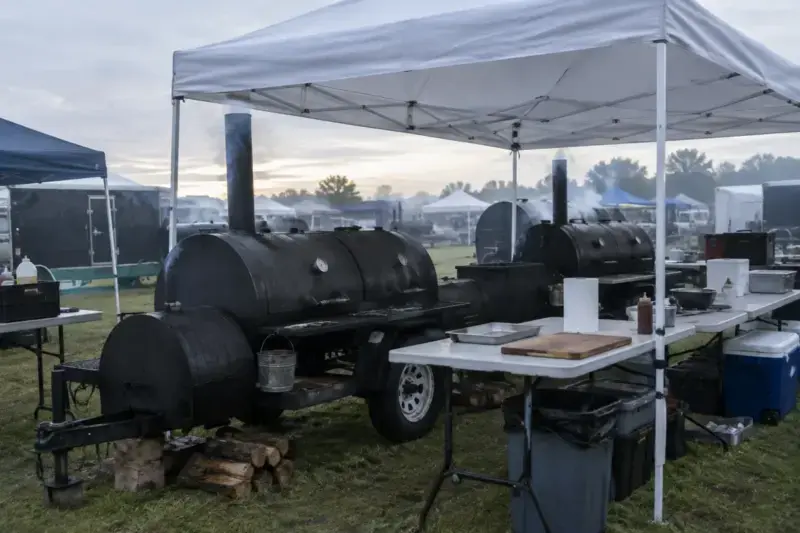
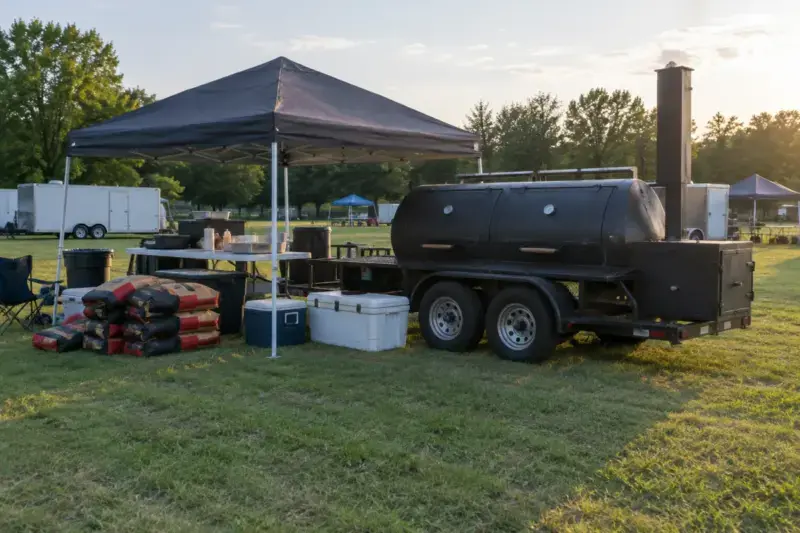
Competition barbecue looks like backyard cooking from the outside and works almost nothing like it. The meat is the same, the fire is the same, and everything else — timing, presentation, what "done" means — is different.
This is how a sanctioned contest actually runs, what the judges are scoring, and why competition cooks do things that look strange until you understand the scoresheet.
Table of Contents
The four categories
A KCBS Master Series contest requires every team to cook the same four meats:
- Chicken
- Pork ribs
- Pork shoulder
- Beef brisket
Everyone cooks all four. There is no choosing your strongest category — the overall standing comes from the combination, which is why teams practise their weakest meat hardest.
The clock is the hardest part
This is what separates competition from every other kind of cooking, and it surprises people more than the cooking itself.
| Category | Turn-in |
|---|---|
| Chicken | 12:00 |
| Pork ribs | 12:30 |
| Pork shoulder | 13:00 |
| Beef brisket | 13:30 |
Each turn-in has a ten-minute window, and every team hits the same window. A late turn-in is not accepted, and the entry receives a 0 in every criterion. That is worse than it sounds: a zero in taste, weighted at 2.2972, is not something the other three categories recover from.
So a team is not cooking four meats — it is landing four separate cooks on four fixed times, thirty minutes apart, with no ability to hold one back or rush another. A brisket that needs another forty minutes at 13:20 is simply a brisket that scores badly.
That single constraint explains most of what looks odd about competition technique: the obsession with thermometers, the hot-and-fast cooks, the wrapping, the coolers used as holding ovens.
What the judges actually score
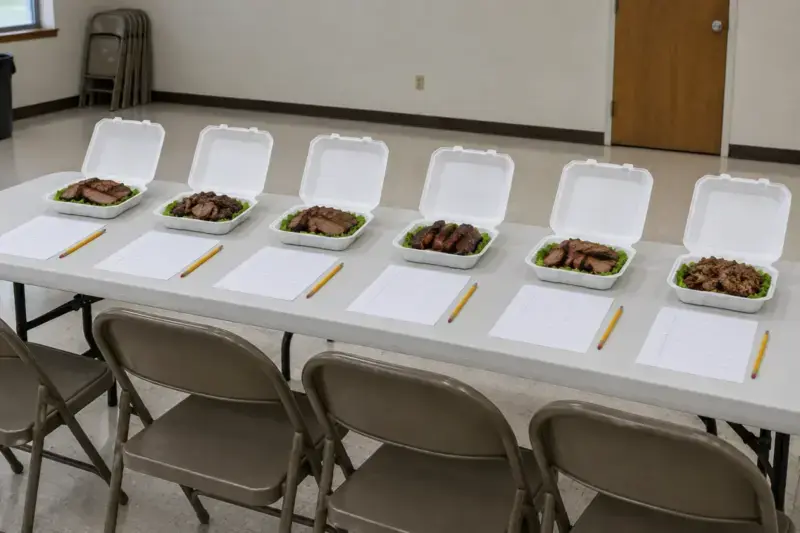
Three criteria — appearance, taste and tenderness — each scored by six judges.
The scale is narrower than it looks. Per the KCBS rules, all whole numbers between
9 and 5 may be used:
- 9 Excellent · 8 Very Good · 7 Good ·
6 Fair · 5 Poor - 2 Inedible
- 1 is a penalty or disqualification, and requires the approval of the
Contest Representative
There is no 3 and no 4. The scale jumps from 5 straight to 2 — which means
there is no gentle way down. A judge who finds something genuinely poor gives it a 5; the next
step below that is "inedible". That gap is why a 5 stings more than the number suggests.
The lowest card is thrown away
Six judges score each entry, and the lowest of the six scores is dropped.
The remaining five are added together.
This matters more than it sounds. One judge who dislikes your sauce cannot sink a category on
their own — the system absorbs a single outlier. But it also means you cannot win on five great
cards and one catastrophe plus luck: consistency across the table is what scores.
A perfect score is 180 points.
The weighting is the thing nobody expects
The three scores are not equal. They are multiplied:
| Criterion | Multiplier |
|---|---|
| Appearance | x0.5600 |
| Taste | x2.2972 |
| Tenderness | x1.1428 |
Taste is worth roughly four times appearance. That is the single most useful number in competition barbecue, and it is routinely misunderstood — including by teams who spend an hour arranging a box and twenty minutes on flavour.
Appearance still matters, because it is the first thing a judge sees and it frames everything after. But if you are trading flavour for looks, the arithmetic says you are losing.
You are not competing against the other teams
Entries are judged against the KCBS Standard — an absolute reference — not against each other. A judge scoring your ribs is not comparing them to the box before yours; they are comparing them to what ribs are supposed to be.
In practice this means a contest where everyone cooks well produces high scores across the board. There is no curve.
Why competition cooks do what they do
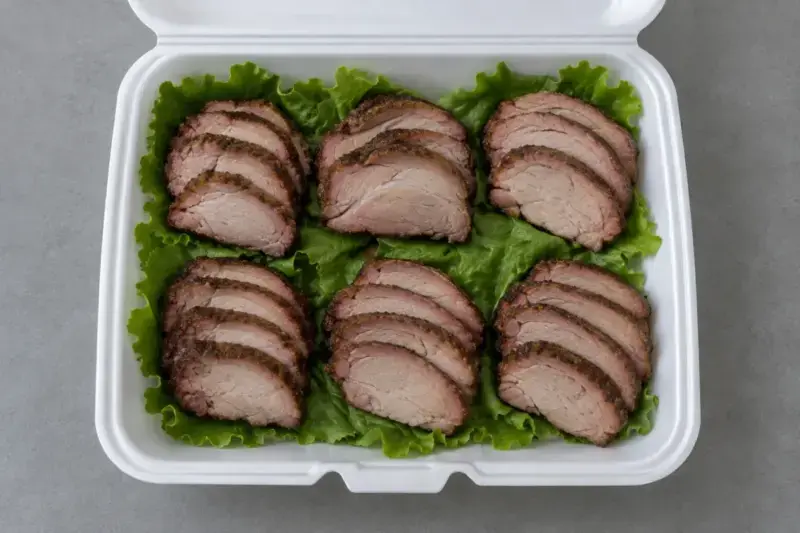
- Separating the money muscle. In pork, the money muscle finishes about fifteen degrees before the rest of the shoulder and gets sliced into medallions for the box. You cannot pull one part off a whole butt, so it comes off separately.
- Injecting. Taste carries the weight, and injection puts flavour inside the muscle rather than only on the bark.
- Cooking hotter than backyard wisdom suggests. The clock does not care about your 225 °F principles.
- Obsessing over thermometers. When a fifteen-minute misjudgement costs a category, guessing is not an option. See our thermometer guides.
- Building the box for the first glance. Appearance is only 0,56 — but it is scored before taste, and first impressions colour what follows.
Getting started
Two ways in, and the second is the one most people should take first:
Cook
Find a local contest and enter the backyard or amateur division rather than the Master Series. Smaller field, lower stakes, same clock — and the clock is the part you need to practise.
Judge
Becoming a certified judge is faster, cheaper, and teaches you more in one day than a season of guessing. You sit at the table, taste sixty entries against the standard, and see exactly what separates a 9 from a 7. Most cooks who judge first say it changed how they cook.
Equipment that competition actually demands
Less than you would think, and different from what you would guess. The cooker matters least — teams win on everything from offset stick burners to pellet grills.
What the format genuinely requires:
- Instant-read thermometer you trust completely. Non-negotiable on a fixed clock.
- Leave-in probes to track long cooks without opening the chamber.
- A cooler that holds temperature for hours — the standard holding solution between "done" and "turn-in".
- Boning knife for separating muscles and trimming clean edges.
- Injector with a wide-bore needle that will not clog on a thick mixture.
Our gear guide covers each of these in more detail, including what to look for and what not to pay for.
Sources
The scoring scale is as announced by the KCBS Rules Committee motion published on kcbs.us. The weighting factors and the dropped low card are rules 10 and 11 of the 2025 KCBS Judging Procedures. Turn-in windows, the late turn-in penalty and the six-portion requirement are rules 12 and 17 of the Official 2026 KCBS Rules and Regulations. The 180-point maximum is not printed in the rulebook; it follows from the weighting factors, which sum to exactly 4.0000, across five counted cards. Local contest rules vary — read the cook packet for the event you entered.
KCBS publishes the rulebook to its members through kcbs.us, behind a member login. The links above are the same documents as hosted in the public cook packets of sanctioned events, which is where a non-member can read them.
If you want to know other articles similar to Competition BBQ: How KCBS Contests Work, and How Judges Score you can visit the category BBQ Competition.
More embers