
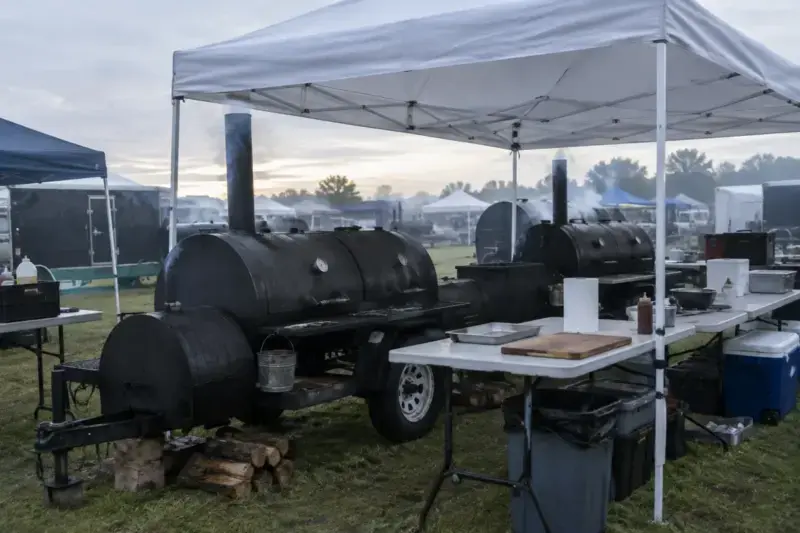
KCBS Rules Explained: Masters Series and Backyard
The KCBS rulebook is a short document that decides a surprising number of contests. Most penalties handed out at a sanctioned event are not for bad cooking — they are for foil left in a box, a stem of parsley separated from its leaf, or a container that arrived ninety seconds late.
This is what the rules require, for both the Master Series (four meats) and Backyard (two), quoted or paraphrased from the Official 2026 KCBS Rules and Regulations and the 2026 KCBS Backyard Rules (KCBS Version 20289). Where a contest's local rules differ, the cook packet wins. For the shape of the day itself, start with how a KCBS contest runs.
Table of Contents
The four Master Series categories
Every Master Series team cooks all four, and the rulebook defines each one narrowly:
| Category | What the rules allow | What is excluded |
|---|---|---|
| Chicken | Chicken, including Cornish game hen and kosher chicken | — |
| Pork ribs | Ribs, which "shall include the bone" | Country style ribs are prohibited |
| Pork | Boston butt, Boston roast, picnic, collar (aka cellar), and/or whole shoulder | Any other cut |
| Beef brisket | Whole brisket, flat, or point | Corned beef is not allowed |
The pork definition catches people. It is a list of specific shoulder cuts; a loin or tenderloin is not on it. Before you trim, know the anatomy of a pork butt and which muscle you are actually turning in.
There is no minimum weight — there is a minimum portion count
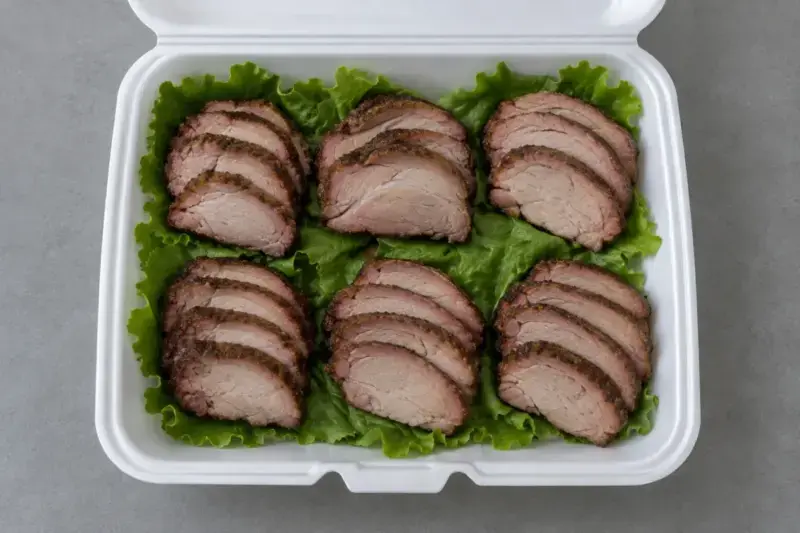
Worth stating plainly, because the opposite is often repeated: the KCBS rules do not specify a minimum weight for any category. What they require instead is at least six portions of meat in the container — one per judge. Chicken, pork and brisket may be chopped, pulled, sliced or diced as the cook sees fit, so long as there is enough for six. Ribs must be turned in bone-in.
Enforcement is harsh: judges may not cut, slice or shake pieces apart to make more samples. If there is not enough meat, the shorted judges score a one on all criteria — and the judges who did get samples change their appearance score to a one as a penalty. A short box does not cost you one card. It wrecks the entry.
Fire, fuel and cooking method
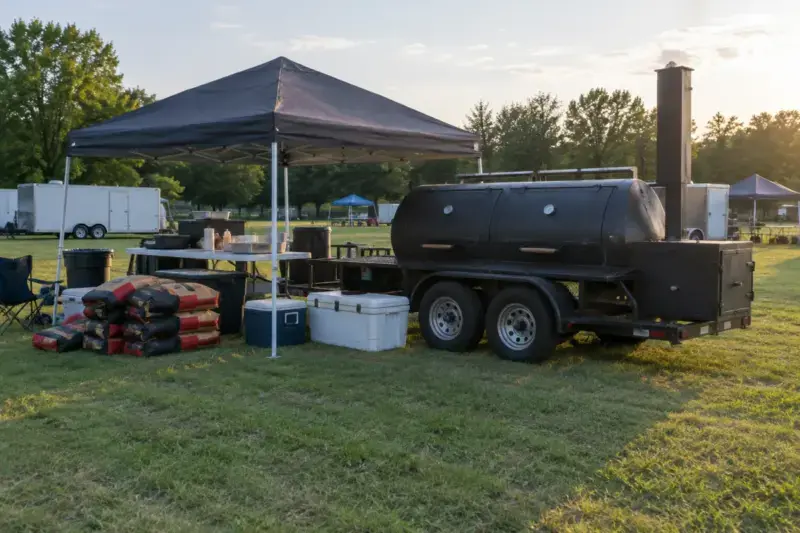
Fires shall be of wood, wood pellets or charcoal. Gas and electric are not permitted for cooking or holding. The exceptions are narrow: propane or electric may be used as a fire starter, provided the meat is not in or on the cooking device at the time; electrical accessories such as spits, augers and forced draft are permitted; and fires shall not be built on the ground.
Three processes are banned outright: parboiling, sous-vide, and deep-frying competition meat. Searing with a gas torch is also prohibited. Chicken, unusually, may be cooked and served breaded.
The penalty depends on when you are caught: before turn-in, the team receives zeros; after turn-in, a one in all criteria for that entry. Using gas or another auxiliary heat source inside the cooking device is separately listed as grounds for disqualification and eviction.
Meat inspection
Inspection is the gate that opens the contest, and cooking before it is not a paperwork slip — it is a scratched entry.
- All competition meat is inspected by the Official Meat Inspector during times set by the organizer, but not before the day before judging. In a multi-day contest, daily for each event.
- A member of the cooking team must be present during inspection.
- Once inspected, the meat shall not leave the contest site.
- Cooking shall not begin until the meat has been inspected, and all competition meat shall start out raw.
The pre-seasoning rule is the one that quietly disqualifies people at the grocery store. No pre-seasoned meat is allowed other than manufacturer enhanced or injected products as shown on the label — and the rules explicitly exclude teriyaki, lemon pepper and butter-injected. The rulebook also addresses transglutaminase ("meat glue") directly, noting it does not season and is not injected. Meat failing these conditions is disqualified, not allowed to be turned in, not judged, and receives no score.
What may be in the box
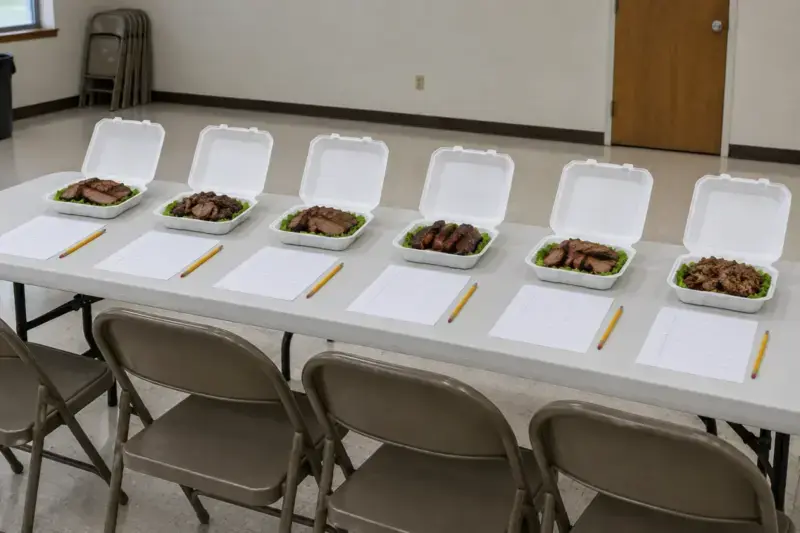
Entries go into an approved KCBS numbered container supplied by the organizer, number on top at turn-in. The rule is restrictive by default: only the acceptable meat for the category being judged and legal garnish may be in the turn-in box.
| Item | Status |
|---|---|
| Aluminum foil, toothpicks, skewers, stuffing, foreign material | Prohibited |
| A hair or brush bristle | Not treated as a foreign item — impossible to determine where it was introduced |
| A bone in the pork entry | Permitted if unaltered and from the approved inspected cut |
| Side sauce containers | Prohibited |
Garnish: a closed list
Garnish is optional, and once determined legal it plays no further role in the appearance score — judges are instructed not to score it. It is not a way to earn points, only a way to lose them. When used, garnish is limited to chopped, sliced, shredded or whole leaves of:
- Fresh green lettuce
- Curly parsley
- Flat leaf parsley
- Curly green kale
- Cilantro
Prohibited are lettuce cores, stems separated from leaves, and other vegetation — the rules name endive and red tipped lettuce as examples, but the list is explicitly not limited to those. Prohibited garnish draws a penalty score of one on appearance. The "stems separated from leaves" clause is the one that costs teams points: a leaf with its stem attached is fine, a stem lying loose in the box is not.
Sauce
Optional. If used, it must be applied directly to the meat and not pooled or puddled in the container. Chunky sauce is allowed, but chunks must be no larger than a fine dice — approximately 1/8 inch cubed. Violations draw a penalty score of one on appearance.
Identifying marks: why they disqualify
KCBS sanctioning allows blind judging only. The scoring system rests on the judge not knowing whose box it is, which is why this rule carries the heaviest penalty in the book.
Two rules apply. Meat shall not be sculptured, branded or presented in a way to make the entry identifiable; rosettes of meat slices are specifically not allowed, and violations are scored a one on all criteria by all six judges. Separately, the container shall not be marked in any way; marked entries, or containers holding prohibited material, receive a one in all criteria from all judges and are disqualified.
There is a carve-out for small objects not visible at appearance scoring — a fragment of foil pushed inside a sample by a probe, say. If it is attached to one removed sample, only that judge scores the penalty; if it stays in the box, only the judges sampling from that point on levy it. But if the Reps decide the object helps identify a team, all judges give a one in all categories.
One line works in your favor: once the sixth judge has taken a sample and the box is closed and released to the leftover table, nothing inside or on it can be used to determine a marked box, illegal garnish, or foreign item.
The clock
Judging typically starts at noon on Saturday, with categories judged in a fixed order thirty minutes apart:
| Category | Posted turn-in | Acceptable window |
|---|---|---|
| Chicken | 12:00 | 11:55 – 12:05 |
| Pork ribs | 12:30 | 12:25 – 12:35 |
| Pork | 13:00 | 12:55 – 13:05 |
| Beef brisket | 13:30 | 13:25 – 13:35 |
The rule reads: five minutes before to five minutes after the posted time, with no tolerance. A late turn-in will not be accepted by a Rep and receives a zero in all criteria.
Cooks use "zero" and "one" loosely, and the difference is real. If you do not turn in, are not allowed to, or are late, the category is not accepted, not judged, and receives no score. If you turn in and are then penalized — no bone in the ribs, say — the entry is judged and receives ones. Both are ruinous, but they are not the same event — and the gap is worth 20 points. Ones still score: the weighting factors add up to 4.0000, so one point per criterion across five counted cards is 1 × 4.0000 × 5 = 20 of that category's 180. A missed or late turn-in scores nothing at all. It is why experienced cooks turn something in every time, even when they hate what is in the box.
Master Series vs Backyard
Backyard exists to promote barbecue in smaller towns and is built around non-professional teams. The cooking rules are near-identical — same fuels, same garnish list, same container rules, same inspection, same turn-in windows. The differences are structural:
| Master Series | Backyard | |
|---|---|---|
| Categories | Four: chicken, pork ribs, pork, beef brisket | Two: chicken, pork ribs |
| Turn-in times | 12:00, 12:30, 13:00, 13:30 | 12:00 and 12:30 |
| Top award | Grand Champion and Reserve Grand Champion on cumulative points across the four categories | Overall Backyard Champion and Reserve Champion |
| Extra categories | Ancillaries cannot be required for Grand Champion consideration | Allowed, but do not count toward Champion or Reserve |
Eligibility changed for 2026. A Backyard team is now any team that qualified as one prior to 2026, plus any team new to KCBS sanctioned events — and those teams may enter any Backyard competition regardless of past or future Master Series participation, Champion status, or how many Masters contests they have entered this year. The constraint is Team of the Year points: Backyard teams earn TOY points only in Backyard events and KCBS-approved Open format Master Series events.
For a first contest, Backyard is the obvious entry point. Two meats instead of four halves the fuel and the meat bill, and removes brisket — the most expensive protein and the hardest to land on a fixed clock. It also removes the 13:00 and 13:30 turn-ins, where inexperienced teams usually come apart.
Cleanliness and safety
Rarely discussed, routinely inspected: no tobacco while handling meat, shirt and shoes required, a bleach/water sanitizing rinse at one cap per gallon, and a fire extinguisher near all cooking devices. The temperatures are specific — meat at 40°F or less before cooking and 140°F or above after, or cooled 140°F to 70°F within 2 hours and 70°F to 41°F within 4. Violating the core rules on cooking space, equipment, cleanliness and fuel is grounds for disqualification and eviction.
Who decides
The rulebook's first line settles most arguments before they start: interpretation of the rules is at the discretion of the KCBS Contest Representatives, and their decisions are final to the extent consistent with the rules. So if something in your box is borderline, ask the Rep before turn-in, not after. A one requires a Rep's approval — which means a Rep is also the person who can confirm it does not apply.
The rules keep you from losing points. How the scoring math works tells you where the points actually are, and it is not where most new teams spend their time. If you are still deciding whether to enter, what a contest weekend costs is the other half of that call, and equipment is where most of the startup money goes.
Sources
Official 2026 KCBS Rules and Regulations, as published in the Southaven Springfest cook packet; 2026 KCBS Backyard Contests Official Rules and Regulations (KCBS version 20289); 2025 KCBS Judging Procedures; and the Rules Committee motion on the scoring scale published on kcbs.us. Local contest rules vary — always read the cook packet for the event you entered.
KCBS publishes the rulebook to its members through kcbs.us, behind a member login. The links above are the same documents as hosted in the public cook packets of sanctioned events, which is where a non-member can read them.
If you want to know other articles similar to KCBS Rules Explained: Masters Series and Backyard you can visit the category BBQ Competition.
More embers