What It Costs to Compete in BBQ
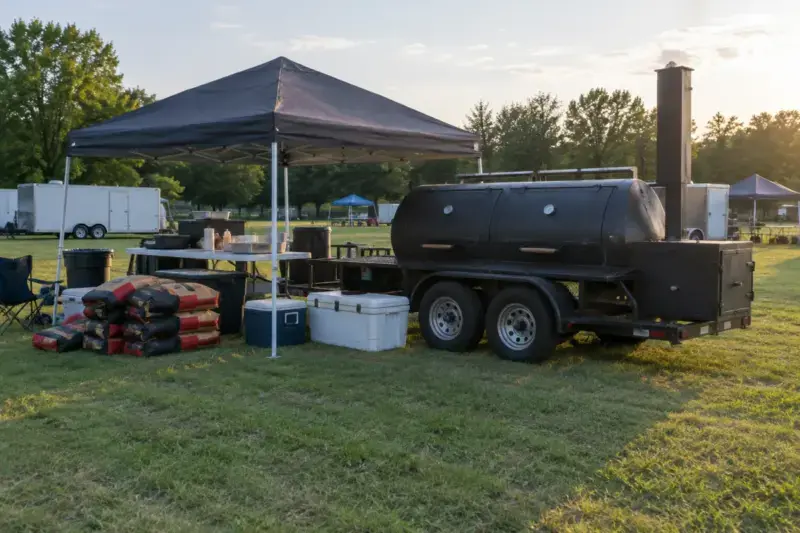
Ask what a barbecue contest costs and you get a shrug and a range. The reason is structural: entry fees are published, and almost nothing else is. Meat, fuel, fuel for the truck, and the rig itself vary so widely between two teams at the same contest that any single number quoted as "the cost of competing" is somebody's weekend, not a benchmark.
So this splits in two: what you can look up before you enter, with sources — then the costs nobody publishes, where the honest answer is what drives them, not a figure.
Table of Contents
Entry fees: the one number you can check
Entry fees are published on contest application forms, which makes them the only reliable figure in the whole exercise. Here are three KCBS contests with fees posted for the 2026 season:
| Contest | Series | Published 2026 entry fee |
|---|---|---|
| E'burg BBQ Contest Emmetsburg, IA | KCBS sanctioned | $225 (Jan 1 – Mar 1) $250 (Mar 2 – May 1) $275 (May 2 – contest) |
| Rose Festival BBQ State Center, IA | KCBS sanctioned | $250 (by Apr 1) $275 (Apr 2 and after) |
| BBQ Gives Back | Master Series | $325 early / $350 regular (one day) $650 early / $700 regular (both days) |
| BBQ Gives Back | Backyard | $200 early / $225 regular (one day) $400 early / $450 regular (both days) |
Three things are worth pulling out of that table.
Early registration is a real discount. Every one of these contests tiers its fee by date, and the gap between the first tier and the last runs $25 to $50. Entering in January rather than May is the single easiest cost reduction available to a team, and it requires nothing but a calendar.
Backyard costs meaningfully less to enter. At BBQ Gives Back the Backyard fee is roughly 60% of the Masters fee for the same day. That is before the saving on meat and fuel from cooking two categories instead of four — Backyard drops pork shoulder and brisket, and brisket is both the most expensive protein on the list and the hardest to land on a fixed clock.
Entry fees are almost universally non-refundable. Both Iowa contests above state it flatly, and the KCBS rules themselves provide that there is no refund of entry fees for any reason except at the organizer's election. If you enter in January and your cooker dies in June, that money is gone.
What the fee does and does not include
This varies enough that it is worth reading the application line by line. BBQ Gives Back publishes what its fee buys: a 50-by-50-foot site with 30 and 50 amp power, 110 volt power, water, cable and wi-fi. The E'burg flyer, by contrast, charges a separate $25 electricity fee with limited availability, and notes the supplied power is meant for smokers and lighters — teams running air conditioning are told to bring their own generator.
The KCBS rules set the default: contestants shall provide all needed equipment, supplies and electricity, except as arranged for in advance. Anything you get beyond a patch of ground is the organizer being generous, not a standard.
Ancillary categories
Most contests run side competitions with their own fees, and they are cheap relative to the main event. At the 2026 Rose Festival: $60 for People's Choice Ribs, and $30 for KidsQ — with the note that meat for KidsQ is provided by Iowa Pork Producers.
Ancillaries are worth knowing about because they change the value of the weekend rather than the cost of it. You are already on site with fire lit. Under the KCBS rules, ancillary categories cannot be required for Grand Champion consideration and no prize money can be withheld for skipping them — so they are genuinely optional.
The costs nobody publishes
Here the honest answer is that there is no public figure worth quoting, and this is the part of the question that the internet has never answered well. The most-cited discussions of what a season actually costs are old forum threads, written by cooks describing their own setups years ago, in a different economy. Treating any of those totals as current is a mistake, so no number from them appears here.
What can be said usefully is what moves each cost, so you can price your own weekend rather than adopt someone else's.
Meat
The biggest single consumable, and the one with the widest spread between teams. What drives it:
- How many categories. Masters is four proteins, Backyard is two. That is close to a straight halving.
- How much you buy per category. This is where teams diverge hardest. The rules require only six portions in the box, but competitive teams cook several briskets or butts and turn in the best one — so the buy is a multiple of what gets judged, and that multiple is a strategy choice, not a rule.
- Grade. Brisket in particular spans an enormous price range by grade, and teams at the same contest will be cooking very different meat.
- Whether the organizer supplies it. Some contests provide meat. The KCBS rules allow it, and set conditions when an organizer provides all four.
Current prices are published by USDA, and it is worth knowing which series you are reading, because the two do not say the same thing. (BLS does not track these cuts at all — its meat series cover things like boneless chicken breast and sliced bacon.)
Wholesale is current. In September 2026 the boxed-beef report put brisket (deckle-off, boneless) at $4.73/lb Choice and $4.53/lb Select (USDA boxed beef cutout); the pork butt primal composite was $1.15/lb (pork carcass and primal report); bone-in chicken thighs were $0.73/lb (poultry market report). These are plant and carload prices — the floor underneath what you pay, not what you pay.
Retail is the number you want, and it is stale. USDA's advertised-retail series has not been updated since August 2024, when it showed whole brisket at $5.03/lb, brisket flat at $8.46/lb, bone-in pork butt at $2.12/lb and spareribs at $2.53/lb (national retail report). Two years on that is history, not a budget.
So the wholesale figure is real but is not your price, and the retail figure is your kind of price but is two years old. The gap between them is your butcher's margin and your state's groceries. Price your own cuts in the week you buy them, and treat anyone quoting a single current national retail price for competition brisket as guessing. If you are deciding how much pork to buy and which part of it you intend to turn in, the anatomy of a pork butt is the thing that determines whether you need one or three.
Fuel
The rules narrow this for you: fires shall be of wood, wood pellets or charcoal, and gas and electric are not permitted for cooking or holding. So the cost is set by your cooker type and the length of the cook, and a stick burner running overnight and a pellet cooker on a controller are not comparable line items. Bag prices are retail and regional, so treat these as a September 2026 snapshot rather than a constant: Kingsford All Natural Original briquettes, 16 lb, $14.99; FOGO Premium lump, 17.6 lb, $19.95; Traeger Premium hardwood pellets, 20 lb, $19.99.
How many bags a contest takes is the part we are not going to invent. An insulated cabinet and a thin-walled offset cooking the same four categories do not burn remotely the same fuel, and the only public consumption figures are cooks' own accounts on forums — useful, but not measurements. Buy more than you think you need.
Travel and lodging
Usually the most controllable cost, and the one that decides whether a season is affordable. Most KCBS contests assign you a cooking space you occupy from Friday setup through Saturday awards, and many teams sleep on site rather than book a room — the E'burg contest is held at a casino resort campground, and BBQ Gives Back's fee includes a serviced campsite. That turns lodging from a per-night hotel bill into part of the entry fee.
Fuel for the truck scales with how far you are willing to drive, which for most teams is the real lever on season cost. The EIA posts a national average every Monday: in the week of 7 September 2026 it was $4.157 a gallon for regular gasoline and $5.967 for on-highway diesel (EIA weekly retail prices). Put that against a 550-mile round trip at an assumed 12 mpg towing — your figure, not a measurement — and you are looking at roughly $190 of gasoline, or $274 of diesel, before a single bag of charcoal. At many contests that is larger than the entry fee. Cooking four contests within two hours of home is a fundamentally different budget from chasing Team of the Year points across several states.
Equipment
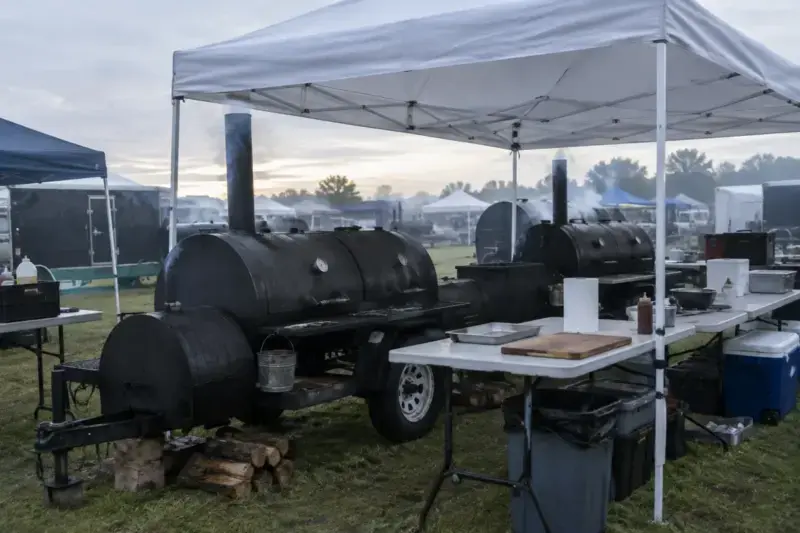
The largest number in the whole exercise, and the least generalizable. A competition setup is a cooker, a canopy, tables, coolers, thermometers and the things that make a 3 a.m. cook survivable. Prices for all of it span at least an order of magnitude, and the honest framing is that there is no "cost of a competition rig" — there is what you already own, plus what you buy to close the gap.
What can be pinned down is the cooker, since those are list-priced. Three routes in, checked in September 2026 at the manufacturer or a national retailer:
| Route | Cooker | Price |
|---|---|---|
| Cheapest credible | Oklahoma Joe’s Highland Classic offset | $429.99 |
| Step up | Old Country BBQ Pits Pecos offset | $599.99 |
| Typical serious rig | Lang 36″ Hybrid Deluxe Patio, insulated reverse-flow | $3,695 |
Those are cooker prices alone. A canopy, two folding tables and a cooler that will hold a finished brisket at temperature add several hundred dollars on top of the cheapest route, and at a contest none of them are optional.
Two things are true regardless of budget. Nothing in the KCBS rules requires an expensive cooker: the rules govern fuel type, not price, and a backyard cooker that holds temperature legally is legal. And the equipment that actually protects your score is the cheap end — thermometers, because the turn-in windows are fixed and unforgiving, and enough cooler space to hold a finished cook while you wait for a window. If you are building out, the gear side of the site covers what the specs mean.
Can you win it back?
Prize money is published, and the arithmetic is not encouraging for the field as a whole.
The 2026 E'burg contest posts $5,000 in cash payouts and awards, with a progressive payout after 30 teams. Set that against the entry fees at the same contest — $225 to $275 per team — and the shape becomes clear: once a contest fills, the teams collectively put more into entries than the posted purse pays back. Payouts also spread across four categories plus overall placings, so the money is divided many ways before anyone touches it.
That is not a criticism of organizers, who are funding judges, site, sanctioning and awards out of the same pot. It is simply the structure. A team that cooks a full season and finishes in the money regularly can offset a meaningful share of its costs. A team cannot plan on the purse covering the weekend, and the ones that consistently do well are generally the ones who have already absorbed the equipment cost in prior years.
One fee that is easy to overlook: the KCBS rules require a current KCBS member — the chief cook or a registered assistant chief cook — to be present for a team to be awarded Team of the Year points. Current dues are set by KCBS and no figure is quoted here, because none could be confirmed from an official source at the time of writing — check kcbs.us rather than budgeting from a number found on a third-party page. Individual membership is $45 a year and family membership $60, with lifetime options at $450 and $600 (KCBS membership page) — the cheapest line on this page if you are cooking a season, and skippable if you are cooking one contest to see what it is like.
The cheapest honest way in
If the goal is to find out whether you like competing before spending like someone who already knows:
- Enter a Backyard contest, not Masters. Two categories, a lower entry fee, and no brisket.
- Register in the first fee tier. Free money, available to anyone who plans ahead.
- Pick a contest close to home and sleep on site if the space allows it.
- Cook on what you own. The rules care that your fuel is wood, pellets or charcoal. They do not care what it cost.
- Spend on thermometers before anything else. The clock, not the cooker, is what beats new teams.
Then read how the scoring actually works before you cook, because the weighting tells you where to put your effort — and effort is the one input in this whole budget that is genuinely free.
Sources and honesty note
Entry fees, electricity charges, ancillary fees and payout figures above are taken from the contests' own published 2026 application materials: the E'burg BBQ Contest flyer hosted at kcbs.us, the Rose Festival BBQ entry page, and the BBQ Gives Back competitor information page. Rules on refunds, fuel, supplied equipment, ancillary categories and KCBS membership are from the Official 2026 KCBS Rules and Regulations. Truck fuel is from the EIA weekly retail gasoline and diesel series; meat prices from USDA AMS (boxed beef, pork, poultry and the national retail report); membership rates from kcbs.us. Cooker and bag prices were checked at the manufacturer or retailer in September 2026 and will drift.
Two things here are deliberately left without a number. The first is how much fuel a given cooker burns over a contest: no public measured figure exists, only cooks' estimates of their own rigs. The second is a single total for “what a weekend costs” — every published breakdown we could find was written between 2011 and 2018, and restating decade-old totals as current costs would be inventing a figure and attaching a citation to it. The components above are current and sourced; add up the ones that apply to you, in the week you are buying.
If you want to know other articles similar to What It Costs to Compete in BBQ you can visit the category BBQ Competition.
More embers