
As an Amazon Associate we earn from qualifying purchases. Product links on this page may be affiliate links.
This is the gear we point people to, organised by what you are trying to cook. Each entry explains what actually matters in that category before it sends you anywhere — because the specification you should be comparing is usually not the one on the front of the box.
Why there are no prices here: grill and accessory prices move constantly, and a page full of stale numbers is worse than no numbers at all. Every link opens the current listings on Amazon, where the price is whatever it is today.
Grills
Start with fuel type, not with a model. Our comparison of charcoal vs gas vs pellet vs kamado covers the trade-offs, and what size grill you need explains why the advertised cooking area is not the figure to compare.
Pellet grills
What matters: a PID controller (holds ±5–10 °F instead of wandering), hopper capacity, and whether the manufacturer sells the auger motor and controller as spare parts. Full detail in our pellet grill guide.
→ Pellet grills with PID control on Amazon
Charcoal grills
What matters: vents at both top and bottom that move in defined increments, steel 1.2 mm or thicker, and a real ash-removal mechanism. See how to choose a charcoal grill.
→ Kettle grills · Barrel grills
Gas grills
What matters: burner count and BTU are less useful than even heat distribution and build quality. Remember gas will not run meaningfully below 250 °F, so true low-and-slow is off the table.
Portable grills
What matters: weight, a lid that latches for transport, and legs that fold without tools. Cooking area of 150–250 sq in is normal and usually enough.
Kamado grills
What matters: ceramic thickness and the quality of the gasket and hinge. Kamados hold heat exceptionally well and overshoot easily — the discipline is creeping up on your target, not chasing it back down.
Smokers
What matters across the board: how well the chamber seals, and how easy it is to add fuel without opening the cooking chamber.
→ Pellet smokers · Offset smokers · Drum smoker kits · Vertical smokers
Thermometers
The single upgrade that improves results more than any other. Built-in lid thermometers read the air near the lid, not the temperature at the grate, and are frequently well off.
- Instant-read — for checking doneness. Speed and accuracy are what you pay for.
→ Instant-read thermometers - Leave-in probe — for long cooks. Look for a probe rated above your maximum cooking temperature and a cable that survives a lid closing on it.
→ Leave-in probe thermometers - Wireless — for overnight cooks. Check the stated range against where you will actually be.
→ Wireless thermometers
More detail in our thermometer coverage.
Safety and handling
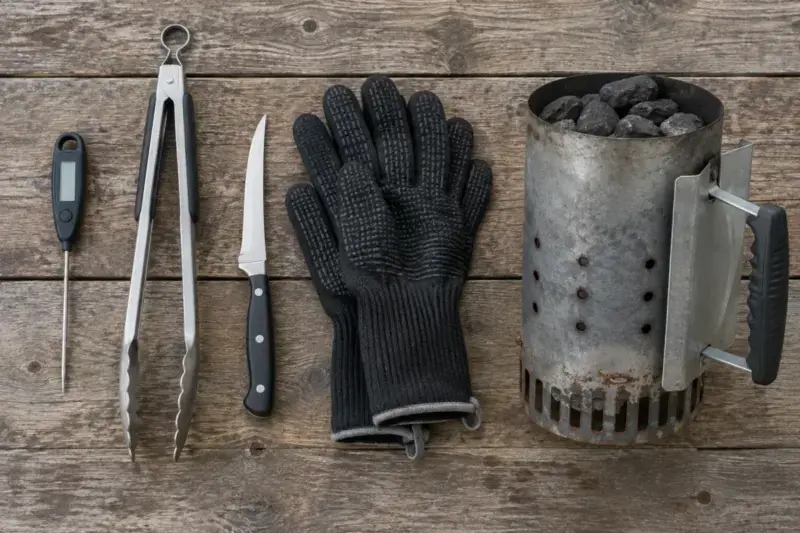
What matters: the cuff length matters as much as the heat rating — most burns happen on the forearm reaching across a grate, not on the fingers. See our notes on BBQ gloves.
Fuel
The most under-rated variable in barbecue. Damp pellets jam augers; low-grade briquettes add ash and off flavours.
- Lump charcoal — burns hotter and cleaner, less consistent in size.
→ Lump charcoal - Briquettes — uniform and predictable, more ash.
→ Briquettes - Wood pellets — buy cooking pellets rather than heating pellets, and store them sealed and dry.
→ Cooking wood pellets - Smoking wood — chunks for long cooks, chips for short ones.
→ Wood chunks · Wood chips
See also our guide to charcoal types.
Rubs and sauces
What matters: check where the salt sits in the ingredient list. A rub that is mostly salt limits how much you can apply before the meat is over-seasoned.
→ BBQ rub sets · Brisket rubs · Sauce variety packs
Tools worth owning
- Chimney starter — lights coals faster and more evenly than any built-in ignition, costs little, never breaks.
→ Chimney starters - Long tongs — 16 inches or more keeps your hand out of the heat.
→ Grill tongs - Grate brush or scraper — bristle-free designs avoid the risk of a wire ending up in food.
→ Bristle-free brushes - Grill basket — for vegetables and anything that falls through a grate.
→ Grill baskets - Cover — check it fits your model's dimensions, not just its category.
→ Grill covers
If you are starting from nothing
The order we would buy in:
- A thermometer. It improves every cook on whatever grill you already have.
- A chimney starter, if you are on charcoal. Removes the worst part of the process.
- Gloves and long tongs. Cheap, and you will use them every single cook.
- The grill. Only once you know which fuel suits how you actually cook.
Most people do this in reverse, buy the biggest grill they can afford, and then discover the thermometer would have made more difference.
We hope you enjoyed this article about BBQ Gear: What to Buy and What to Look For.