
How KCBS Scoring Works: Reading Your Score Sheet
KCBS scoring is arithmetic, and the arithmetic is public. Once you can do it, your score sheet stops being a verdict and becomes a diagnostic — it tells you which of three things went wrong, and roughly by how much.
Everything below comes from the KCBS Judging Procedures, published as part of the official rules and distributed in contest cook packets. The numbers are not estimates.
Table of Contents
The scale is not 1 to 9
This is the single most repeated error about KCBS scoring, including in places that should know better. The rule reads:
The scoring system is all whole numbers inclusive of 9 through 5 and 2: The following whole numbers may be used: 9-excellent, 8-very good, 7-good, 6-fair, 5-poor, and 2-inedible.
There is no 3 and no 4. A judge cannot give them. The usable scale is six numbers wide, not nine, and it is deliberately lopsided:
| Score | Meaning |
|---|---|
| 9 | Excellent |
| 8 | Very good |
| 7 | Good |
| 6 | Fair |
| 5 | Poor |
| 2 | Inedible |
| 1 | Penalty or disqualification only — requires a Contest Rep's approval |
The gap between 5 and 2 is the important part of the design. There is no gentle slope into failure. A judge who thinks your entry is worse than "poor" has only one option left, and it is a cliff. In practice this compresses almost all real scoring into the 6–9 band, which is why a single 5 on a card is a much louder signal than it looks.
A one is a different object entirely. It is not a low opinion; it is a penalty, and it requires a Rep to sign off. All judges give a one in appearance for prohibited garnish, pooled sauce, or fewer than six samples. All judges give a one in all criteria for sculptured meat, a marked container, a foreign object, or incorrect meat. If you have a one on your sheet, you broke a rule — you did not cook badly.
The three criteria are not worth the same
Each entry is scored on appearance, taste and tenderness. Those three raw scores are then multiplied by fixed weighting factors:
| Criterion | Weighting factor | Share of the total |
|---|---|---|
| Appearance | 0.5600 | 14.00% |
| Taste | 2.2972 | 57.43% |
| Tenderness | 1.1428 | 28.57% |
The three factors sum to exactly 4.0000, which is not a coincidence — it is what makes the rest of the math come out in round numbers.
Two ratios fall out of this and they are the whole strategic content of the scoring system:
- Taste is worth 4.1 times appearance. (2.2972 ÷ 0.5600)
- Taste is worth 2.0 times tenderness. (2.2972 ÷ 1.1428)
Appearance is 14% of the score. It is the first thing a judge sees and it frames what follows, but as a points source it is small. A team that spends an hour building a box and twenty minutes on flavor has the weighting backwards.
Six judges score it, five count
A table of six judges scores each entry. Then: the low score is thrown out. Only five cards are tallied.
This is the system's shock absorber. One judge who dislikes your sauce, or who is simply scoring harder than the rest of the table, cannot sink an entry on their own. It also means the practical target is not "please six judges" — it is "give five judges nothing to complain about."
The tie-break procedure confirms how it works, and is worth knowing. If two entries tie in a category, the computer compares the cumulative scores of all five counted judges in taste first, then tenderness, then appearance. If still tied, the discarded low scores are compared and the higher of the two low scores wins. If it is still tied after that, a computer-generated coin toss decides it.
Note what that ordering says: taste breaks ties first. The hierarchy is consistent all the way down.
Working out the maximum
KCBS does not print a maximum score in the rulebook. But it follows directly from the published figures, and the arithmetic is worth doing once so you know where the ceiling is.
One judge's perfect card:
9 × 0.5600 = 5.0400
9 × 2.2972 = 20.6748
9 × 1.1428 = 10.2852
Total: 36.0000
Five counted judges × 36.0000 = 180.0000 per category. Across the four Master Series categories, a theoretical maximum of 720.
So a "perfect 180" is real, and it means something exact: all six judges gave straight nines, or at least the five that counted did. It is not a round number somebody invented — it is 5 × 9 × 4.
Because the factors sum to 4 and five cards count, there is a clean rule of thumb hiding in there: one full point of movement, on every criterion, from every counted judge, is worth exactly 20 points. That gives you a reference ladder for reading any score at a glance:
| If every counted judge scored… | Category total |
|---|---|
| Straight 9s (excellent) | 180.0000 |
| Straight 8s (very good) | 160.0000 |
| Straight 7s (good) | 140.0000 |
| Straight 6s (fair) | 120.0000 |
| Straight 5s (poor) | 100.0000 |
| Straight 2s (inedible) | 40.0000 |
| Straight 1s (penalty) | 20.0000 |
Memorize 160 as "very good across the board." Most competitive scores live between 160 and 175, which is a narrow band — and that is exactly why the weighting matters so much.
A worked example
Here is a brisket scored by a table of six. Raw scores on the left, weighted values on the right:
| Judge | App | Taste | Tend | Weighted total |
|---|---|---|---|---|
| 1 | 9 | 9 | 8 | 34.8572 |
| 2 | 8 | 8 | 9 | 33.1428 |
| 3 | 9 | 8 | 8 | 32.5600 |
| 4 | 8 | 9 | 9 | 35.4400 |
| 5 | 9 | 7 | 7 | 29.1200 — dropped |
| 6 | 8 | 9 | 8 | 34.2972 |
| Category score | 170.2972 | |||
Judge 5 gave the same appearance score as the best cards on the table and still produced the lowest total, because their sevens landed on the two criteria that carry weight. That is the system working as designed.
Now run the counterfactual. If judge 3 and judge 6 had scored taste a 9 instead of an 8 — one point, two judges — the entry gains 2.2972 twice, or 4.59 points. To gain the same amount from appearance you would need to move roughly eight judge-points. There are only five cards and three criteria. That arithmetic is not available.
Reading your own score sheet
You get your cards back. Here is how to extract something useful from them.
Look at the spread before the average
Six judges scoring a 7, 7, 8, 8, 7, 8 are telling you something different from 9, 9, 6, 9, 5, 9 — even if the totals are similar. Tight clustering means the table agreed, and agreement means the signal is about your cooking. A wide spread usually means something inconsistent went into the box: one dry slice, one sample cut from the flat and another from the point, uneven sauce.
Inconsistency across a box is the most common fixable problem in competition barbecue, and it shows up as spread, not as a low average.
Compare across criteria, not across contests
Because the criteria are weighted so unevenly, raw scores across the three are not directly comparable. A 7 in appearance costs you 1.12 points against a 9. A 7 in taste costs you 4.59. Read the taste column first, tenderness second, appearance last — in that order, every time.
Know what tenderness actually measures
Tenderness at 28.57% is the quiet category. It is not "as soft as possible" — for ribs, meat that falls off the bone is scored down, because the standard is a clean bite that leaves a mark without pulling the whole rack apart. A low tenderness score with a high taste score is the most actionable card you can get: your seasoning and smoke are right, your cook time or your wrap is not.
Treat a single outlier as noise, and a pattern as data
One low card in one category at one contest is what the drop rule exists to absorb. The same category scoring low across three or four contests is a real signal. Track category totals across the season rather than agonizing over individual cards — a run of 158s in chicken while pork sits at 172 is the sort of thing that tells you where to spend practice weekends.
What judges are not allowed to do
Two procedural rules shape your scores more than most cooks realize.
First, entries are judged against the KCBS standard, not against each other. The rules are explicit: "Ranking of entries to determine a score is not allowed. Each entry should be judged on its own merit without comparison of other entries." There is no curve. At a contest where everyone cooks well, everyone scores well.
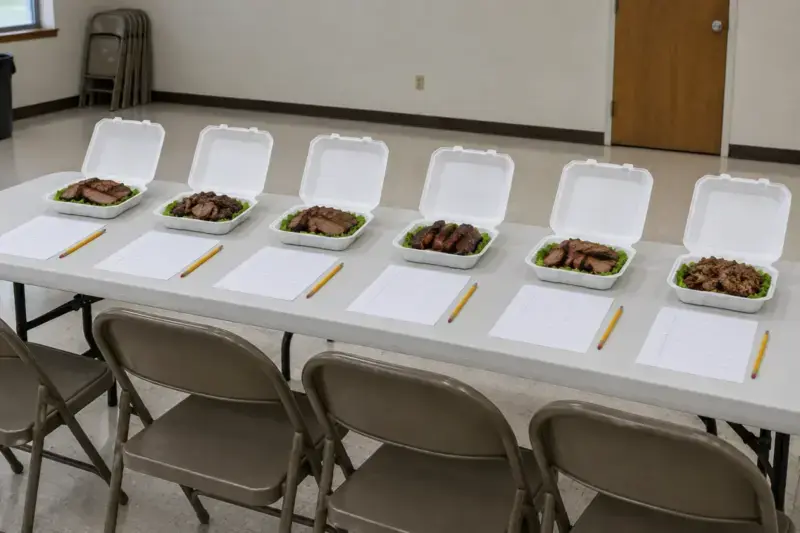
Second, appearance is scored for every box at the table before any sampling begins. The containers are then passed around and each judge takes a sample from each box, scoring taste and tenderness one entry at a time before moving to the next. This is why a box has to look right on the first pass, in sequence with five or nine others — and why nothing you do after that first look can recover an appearance score.
Contest Reps may remove a judge for, among other things, advising other judges how to score, or scoring too high or too low. The system is actively policed for outliers.
What to do with the information
The practical conclusion of all this arithmetic is uncomfortable for a lot of teams: the box matters least of the three things you can control.
Appearance is 14%, and once garnish has been ruled legal it is not scored at all — it is only a way to draw a penalty. The remaining 86% is flavor and texture. If your prep routine allocates time in the opposite proportion, the scoring system will keep telling you so, one 160 at a time.
The other conclusion is that consistency beats peaks. Because the low card is dropped and five are counted, a box where every sample is the same is worth more than a box with two outstanding pieces and four ordinary ones. Six identical samples, cut from the same part of the same muscle, sauced the same way — that is what the math rewards.
For the rules that generate the ones and zeros in the first place, see the KCBS rules explained. For how the contest day is structured around these turn-ins, start with how KCBS competition barbecue works. And if you are weighing whether the season is worth it, what it costs to compete puts numbers on the other side of the ledger.
Sources
Scale, weighting factors and the dropped low card: rules 6, 10 and 11 of the 2025 KCBS Judging Procedures, and the Rules Committee motion published on kcbs.us, which gives the reasoning for removing 3 and 4. Penalty scoring and turn-in rules: the Official 2026 KCBS Rules and Regulations. The 180 and 720 maximums are not stated in the rulebook; they are computed here from the published weighting factors and the five-card tally.
KCBS publishes the rulebook to its members through kcbs.us, behind a member login. The links above are the same documents as hosted in the public cook packets of sanctioned events, which is where a non-member can read them.
If you want to know other articles similar to How KCBS Scoring Works: Reading Your Score Sheet you can visit the category BBQ Competition.
More embers